Capture family stories
Use guided prompts to ask parents, grandparents, and relatives what only they can tell you. Nobody has to write an essay or put on a performance.
A voice-first family space
Corrido helps you capture family stories, traditions, and generational knowledge in the voices of the people who lived them. It keeps those recordings organized so your family can still find them, understand them, and hear them again, including the voices of loved ones who are no longer here to tell them.
Use guided prompts to ask parents, grandparents, and relatives what only they can tell you. Nobody has to write an essay or put on a performance.
Record the stories, values, and traditions your kids or grandkids will want to ask you about someday.
What disappears first
Families carry more than dates and names. They carry traditions, recipes, warnings, jokes, hard-won knowledge, and the reasons behind choices that shaped everyone who came after. Some of that still lives in people you can call today. Some of it lives only in memory: parents, grandparents, and loved ones who are already gone.
Left alone, those stories scatter into camera rolls and half-finished conversations. The stories you keep meaning to record are the ones you'll wish you had.
Corrido gives those stories and voices a place to stay. Each one is tied to people and context, so your family keeps more than files. You keep understanding.
How Corrido helps
Corrido doesn't stop at recording. Each conversation becomes part of a family record you can return to, add to, and grow over time.
How it starts
Corrido gives families prompts that get at the meaning in ordinary stories, without turning the moment into homework. You can record family history, traditions, and turning points. You can also capture life lessons, values, and the context behind important choices.
Record in the room, on a walk, or during a long call. You keep the voice and what it meant, and every conversation makes the record more useful.
How it becomes useful
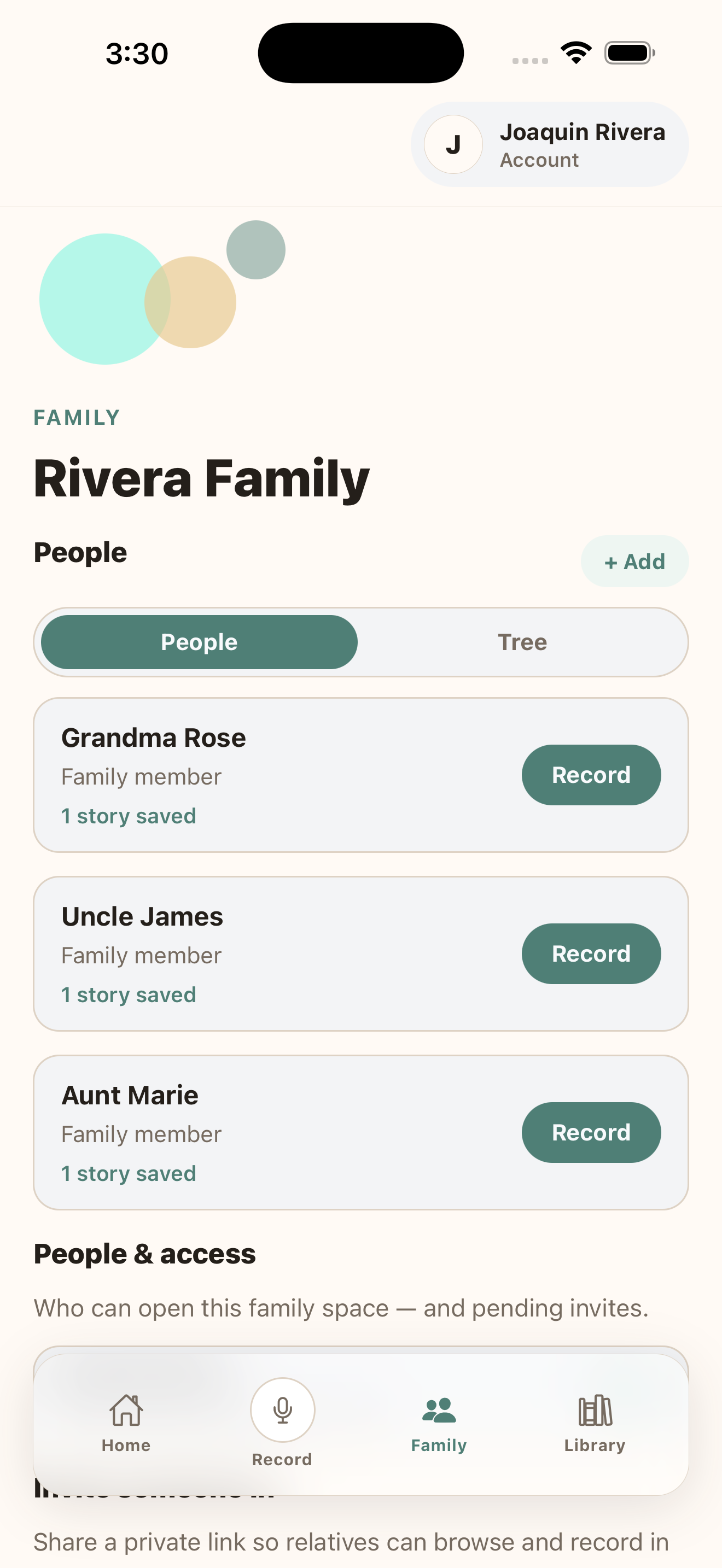
A family tree shows who is related to whom. Corrido also ties people to the stories, places, lessons, and traditions around them. Later, someone can look up a person, a branch, a topic, or a moment and find the voices and details that make the history make sense.
You don't need a perfect genealogy chart on day one. Start with one conversation, then add people and context as you go.
Corrido stays easy enough for one conversation today, and structured enough that every contribution still connects to the rest.
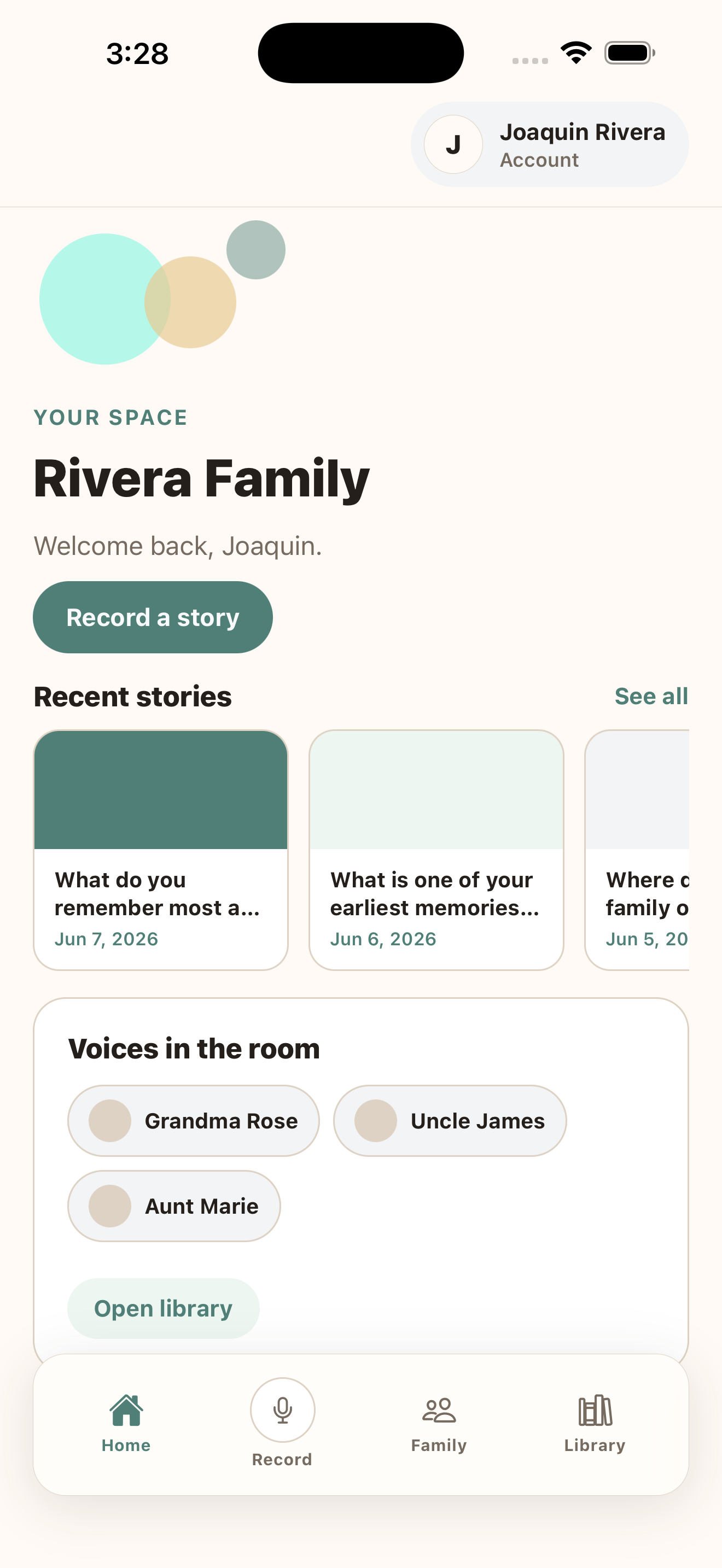
Your family record, a prompt to start with, and a clear next step.
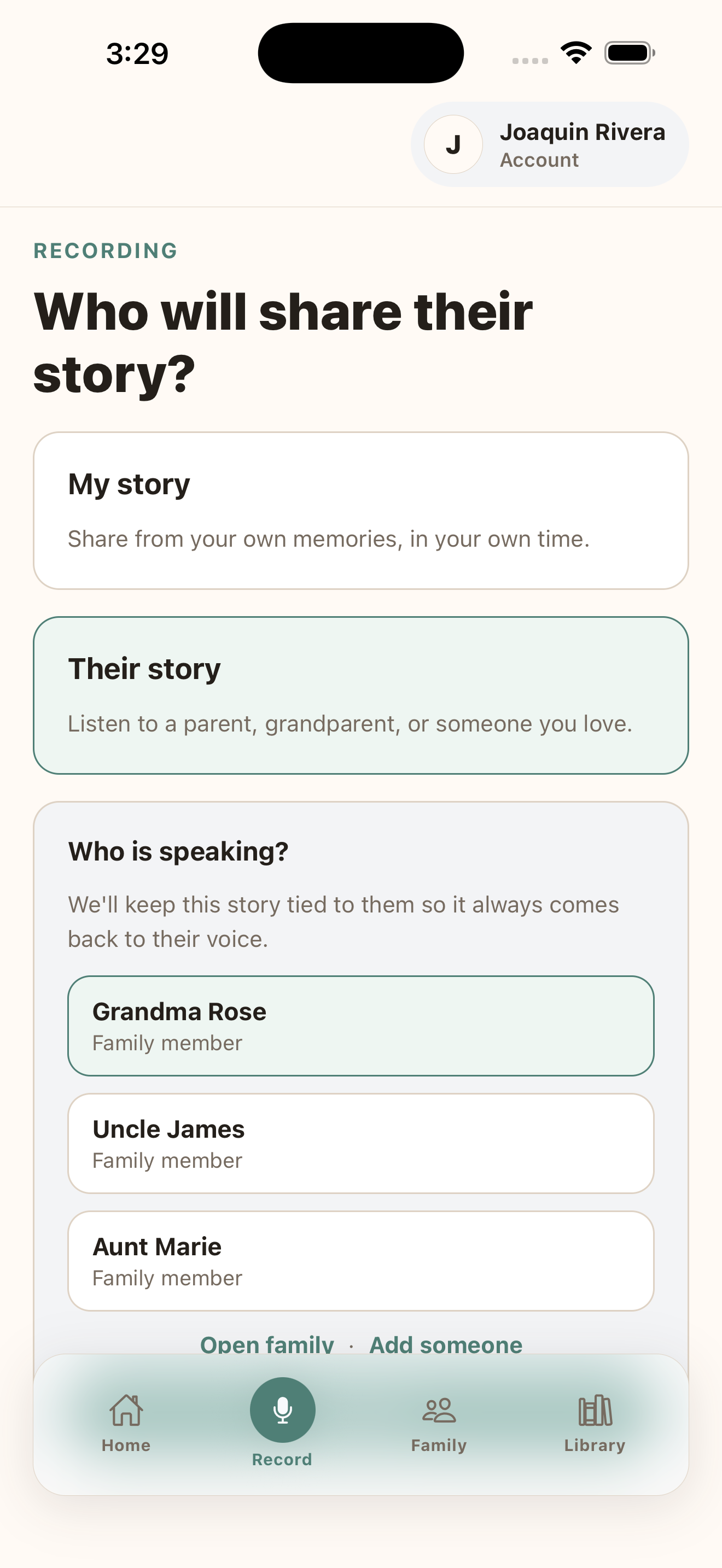
Choose who is speaking and what the story is about, so the conversation lands with context instead of as a loose file.
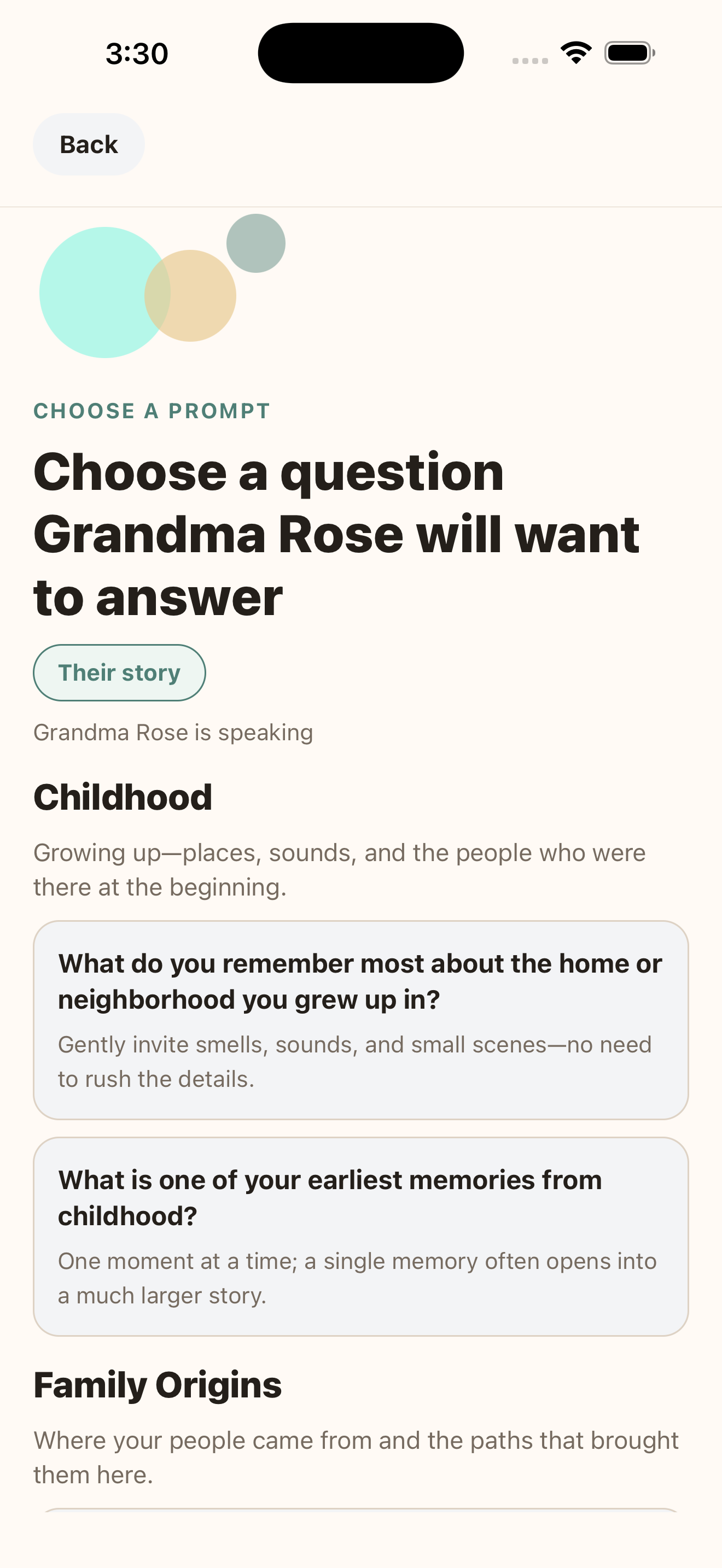
Pick a question so the recording has a clear place to live.
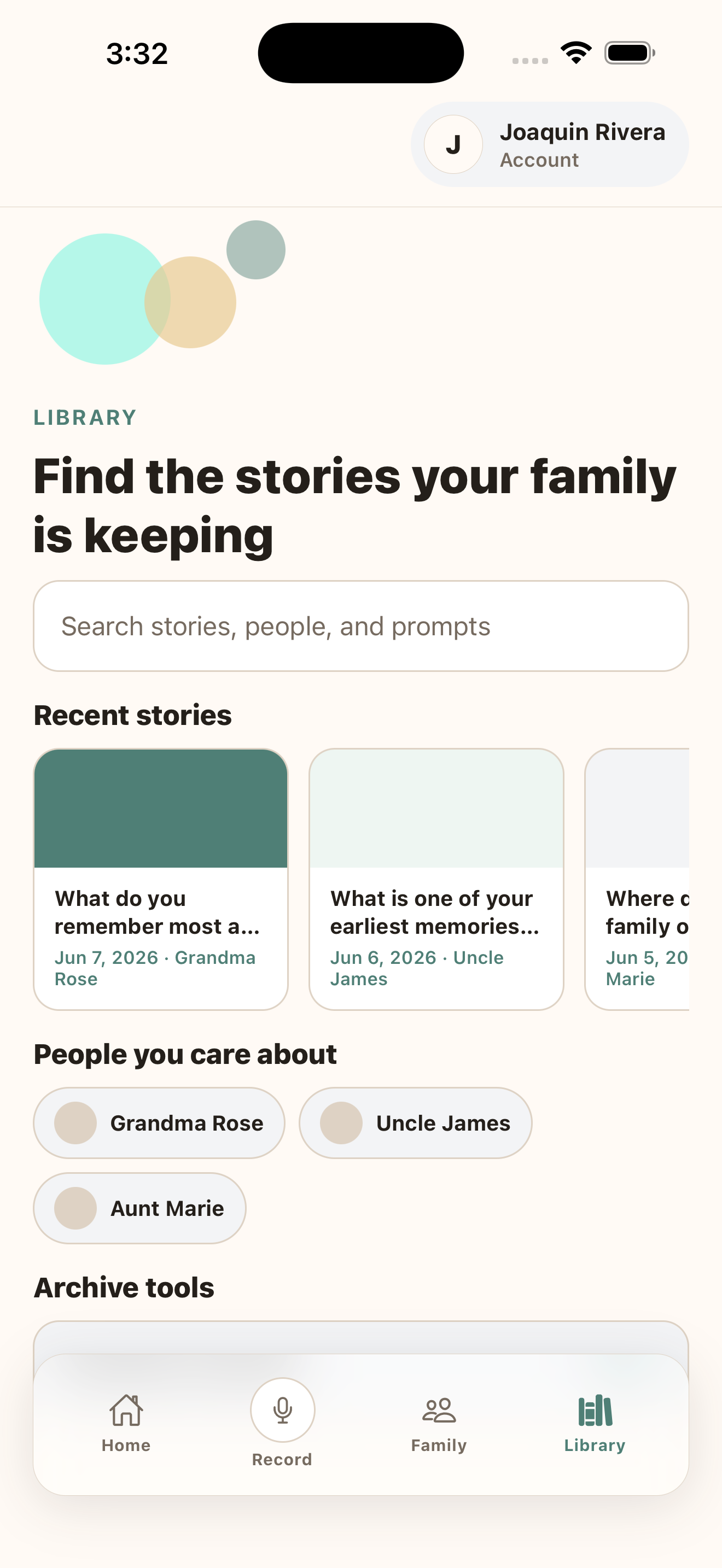
Search people, stories, themes, and family branches when you need them later.
The record gets more useful every time someone contributes, connects, or searches.
Interview someone today, record your own context tomorrow, and invite relatives as the family record grows.
Stories stay tied to people and themes, so later generations can find them and understand them.
Corrido's built for households and the people who come after you, not for a public feed. It isn't a genealogy records tool, and it isn't a one-off gift book.
I'd always wanted to ask my parents more about what their lives were like growing up, but it never felt natural. I'd think of questions I wanted to ask, then when we were actually together, bringing them up out of nowhere just felt kind of awkward.
My grandma was actually the first person in our family to download Corrido. She invited me, and that ended up giving me an easy way to start recording stories with my parents.
The prompts helped a lot. Instead of me trying to come up with some big meaningful question, we could just pick one and start talking. From there, the conversation usually went in directions I wouldn't have expected.
I've learned things about where my parents grew up, what their families were like, and little stories I had never heard before.
It's funny that my grandma was the one who introduced me to Corrido, but now we're using it to make sure those stories don't get lost.

Sofia Ramirez
I've been able to sit down with family members and capture memories about their childhood, the people they grew up around, and things that happened long before I was born.
Hearing them tell those stories in their own words makes them feel so much more real than just hearing someone else retell them later.
Knowing those recordings are there for my family to come back to someday is probably my favorite part.
I'm not just trying to remember the stories correctly anymore. We actually have them.

Claire Bennett
Families also use Corrido to keep recordings and stories about loved ones who are gone. You know the voice you wish you still heard. Keep it here so their voice and what they meant aren't left only in scattered files or fading memory.
Corrido's a family space that keeps growing, not a one-off gift. Start free, then subscribe in the app if the family outgrows those limits.
Download and start a family space today.
$0 to start
Download CorridoWhat's included
Recommended
Less than a coffee a month to keep every voice.
$79.99 /year
Save 33% vs monthly. Or $9.99 / month.
Download CorridoWhat's included
No card needed. Billed securely through the App Store or Google Play. Cancel anytime. Refunds follow store policy. US prices shown. Apple and Google set the amount billed in your store. See the pricing page for the full comparison.
Corrido's available on the App Store and Google Play. Create a free account, record a conversation, keep a tradition, or preserve a voice your family still needs to hear.
Corrido's for family spaces. The point is to keep stories for relatives and future generations, not to publish them to a public audience.
No. Corrido is for anyone whose stories belong with the family, including grandparents, parents, siblings, aunts, uncles, cousins, and chosen family.
A folder stores files. Corrido connects stories to people, prompts, topics, and relationships so they are easier to find, understand, and keep.
Yes. You can preserve recordings and stories about loved ones who are gone, so their voice and what they meant to the family are still here.
Download Corrido, create a free account, create or join a family space, and record your first story. Free includes 5 stories, 5 family members, and 3 contributors. If your family needs more, you can upgrade to Corrido Unlimited in the app.
No. Start with one conversation. Add people, relationships, and themes as you go.
Voice keeps warmth, pacing, names, laughter, and emotion that text often loses.
Yes. Corrido is on the App Store and Google Play.
Yes. Corrido is free to download and start. Free includes 5 stories, 5 family members, and 3 contributors. Corrido Unlimited is an optional in-app subscription at $9.99 per month or $79.99 per year in the US stores if your family outgrows those limits.
If you own a family space, you can export a backup of that family's recordings and notes from the app. If you delete your account, your stories aren't in those spaces anymore. Remaining members can still listen to families you own, but they can't add new stories. We can't promise Corrido will be here forever. If a voice is too important to lose, export a copy and keep it somewhere you control.
Yes. Corrido is a mobile app for iPhone and Android. Recording and listening happen on the phone. There's no web recorder today.

I'm Wes. I built Corrido because family stories kept living in camera rolls and half-finished conversations, and I wanted a place that kept the voice and why it mattered. Corrido's made by Wknd Builds LLC and operated by me. If you're trusting us with a parent's voice, you should know who is on the other side of that family space.